I recently became aware that there is a meme about my name - well, a derivative thereof. Maybe you saw it: My name is Karen, and I want to speak to the manager.
Maybe you've seen it. Well, I'm a white, suburban mama, and I have no objection to "live * laugh * love" although I prefer the mantra "grateful * thankful * blessed". I have asked to speak to the manager Many times. The irony here is: the number one prevailing reason I ask to speak to the manager, is to pass along a compliment about the employee's level of service, and knowledgeableness.
That being said, in this past month, I have:
Contacted customer service at Wal-Mart for a refund of a Wal-Mart pickup item I did not receive. Refund granted.
Contacted customer service at Wendy's about items not received in my pickup order. Funny story - the manager reached out to me, apologized, and offered me a free sandwich whenever I chose to come in and pick up the missing item. When I did go a few days later, they knew exactly who I was, and filled my order right away. They were so pleasant and polite about the situation that I reached out to costumer service again, this time to compliment the staff of that Wendy's location.
Contacted customer service at Amazon to verify that a return had been received, and an email suggesting my card would be recharged had been sent erroneously. Granted.
Contacted Olive Garden and asked to speak to the manager about my to-go order, which was missing my daughter's meal. And yes, I did express disappointment at the level of service, as we also had needed to ask them to bring out missing drinks from the order. Unfortunately, the rest of the order wasn't easily accessible enough for us to check that we'd received everything else until we'd returned home. I asked that the kids meal be refunded, and that I only be charged for the sprite that we did receive. The manager generously refunded the entire order.
And this morning, when asked for survey feedback about my Wal-Mart online ordering experience, I was not shy about expressing my displeasure with the glitchy app that prevented me from completing my order for over twelve hours, resulting in a delay of more than 48 hours for me.
I believe in asking to speak to the manager. I believe in leaving good reviews, and sharing positive feedback. I also believe that it's okay for me to get what I have paid for, and for me to notify someone if there's a problem.
A good manager is a problem solver, and a facilitator. They make sure things run smoothly, and when things don't run smoothly, they sort things out. So, my name is Karyn, and this is me, saying thank you to the managers.

01 December 2019
Let's be civil.
Dear Stranger,
I recently heard a woman, whose professional career is being a YouTube influencer, mention a hateful comment someone had posted to one of her videos. She then went on to relate the experience of one of her friends, also a professional YouTube vlogger, who is being harassed online by someone who has created a Twitter account dedicated to the sole purpose of belittling and demeaning this woman. This is appalling.
It's possible that these hateful people would say hurtful and degrading things right to these two women's faces, but on the whole, I think not. I think it's possible, maybe likely, that in their real lives, these bullies would at the very least maintain a respectful silence on the perceived faults of others, and reprimand their children if they displayed similar vulgar behavior. Instead, so many people are using the impersonal glare of their computer or phone screens to distance themselves from the realities and consequences of their virtual abuse. In a way, this may be a more authentic and realistic glimpse into the true characters of these rude and inconsiderate posters, but I hope not.
The first meme I ever saw on the internet, long before I knew what a meme was, was a commentary on Barbara Streisand's nose. My immediate thought was, "Really? That's the first thing that would come out of your mouth if you were introduced to Ms. Streisand? Telling her you think her nose is too big? Well, That's more than a little rude."
Let's not be that way. Let's not contribute to the hate and cruelty of the virtual world - that world is a lot more real than you might think, and it's full of real people, with real feelings. Let's take a stand, and be firm in our determination to treat people with dignity and respect. Even those people who are not extending that same courtesy to us.
Thank you for making the world a better place.
Sincerely,
Karyn
I recently heard a woman, whose professional career is being a YouTube influencer, mention a hateful comment someone had posted to one of her videos. She then went on to relate the experience of one of her friends, also a professional YouTube vlogger, who is being harassed online by someone who has created a Twitter account dedicated to the sole purpose of belittling and demeaning this woman. This is appalling.
It's possible that these hateful people would say hurtful and degrading things right to these two women's faces, but on the whole, I think not. I think it's possible, maybe likely, that in their real lives, these bullies would at the very least maintain a respectful silence on the perceived faults of others, and reprimand their children if they displayed similar vulgar behavior. Instead, so many people are using the impersonal glare of their computer or phone screens to distance themselves from the realities and consequences of their virtual abuse. In a way, this may be a more authentic and realistic glimpse into the true characters of these rude and inconsiderate posters, but I hope not.
The first meme I ever saw on the internet, long before I knew what a meme was, was a commentary on Barbara Streisand's nose. My immediate thought was, "Really? That's the first thing that would come out of your mouth if you were introduced to Ms. Streisand? Telling her you think her nose is too big? Well, That's more than a little rude."
Let's not be that way. Let's not contribute to the hate and cruelty of the virtual world - that world is a lot more real than you might think, and it's full of real people, with real feelings. Let's take a stand, and be firm in our determination to treat people with dignity and respect. Even those people who are not extending that same courtesy to us.
Thank you for making the world a better place.
Sincerely,
Karyn
16 April 2018
A review of Elena L. Botelho and Kim R. Powell's book, The CEO Next Door

The CEO Next Door, by Elena L. Botelho and Kim R. Powell, calls to mind the title of Thomas J. Stanley's book, The Millionaire Next Door, so I was expecting it to be a little bit more of the same, possibly even in connection with the Millionaire series. I find myself enjoying The CEO Next Door more, because it focuses more on the habits and choices of the people who form the basis of the book. Where The Millionaire Next Door focuses more on specific attributes, and slightly unhelpful data about the consumption habits of millionaires, The CEO Next Door is somewhat more akin to The 7 Habits of Highly Effective People in that it is more principle-based.
I can almost imagine The CEO Next Door being presented in a business meeting; it has a clear, concise format, with main points, summaries, and even a flow chart of sorts. Each set of habits is stated in a concise way, followed by anecdotal and empirical evidence to support the assertion.
I guess I could argue that I'm co-CEO of my household, but the fact is, I haven't been "gainfully employed" for almost 10 years now, so this might seem like an odd choice of book for me to read. However, I selected it in part because my husband is in a managerial position at work, and I was curious about whether the book would have any good advice for him in his work, even though neither he nor I have CEO aspirations. The other reason I selected the book was to see if it had any helpful advice for me. After all, running a household does have some parallels to running a business.
I'm planning on having my husband read the book later, because I found it understandably more applicable to the workplace, but I did find value in the book for myself. I felt like it was a good read, and did not consider my time to have been wasted reading it.
08 March 2018
A review of David Allen Sibley's postcard collection, Sibley: Birds of Land Sea and Sky

This collection of postcards by David Allen Sibley is easily one of my favorite things I've ever recieved in the mail. I could have reviewed it the minute I opened the box. The quality of the paper makes me feel all grown up and professional, and the artwork is like a gallery of fine art prints unto itself (which I'm sure it has been at one point). It made me want to frame them and put them on the wall.
The birds are absolutely gorgeous. The box separates the birds into five categories: waterfowl, woodpeckers, wading birds, songbirds, and owls and raptors; and there are really great examples of each one. I love that there is a very simple and clean look to all of the cards, but that the birds themselves contain the rich details of their models.
This book also has brownie points, because my mother is a bird-lover, and I have many memories of her pointing birds out to me on drives and in our own backyard. I have thus far sent her two postcards, each of which had personal meaning for me, because of our shared experiences. I absolutely love this postcard set. And, be real, postcards are just super fun.
I received this book from Blogging for Books in exchange for my review. This is my honest opinion about the book.
18 February 2018
To people who need a lift
Dear Stranger,
Sometimes, we all feel a little blue. Or a lot blue. When I was sixteen, I wrote a poem, a refrain of which was:
I can't grow up, and I can't grow down.
I'm in too deep, and I'm going to drown.
I have bipolar disorder, most frequently manifested by long bouts of depression. I get feeling low. I truly appreciate the God-given talents of others to lift our souls. There are so many talented and brilliant people out there, y'all. I am sometimes blown away by how amazing people are. Like the people who designed the bed frames my girls use; assembly instructions: tighten two screws! That right there lifts my soul, and I'm not even being facetious.
Media can be so depressing, even destructive at times, but there are so many great things out there. My friend's mom once told him that he would never be "missing out" by avoiding dirty songs and movies - and whatnot - because he would never run out of things worthy of his attention. These are things I consider worthy of our attention, and soul-lifting:
The short film: Validation

Some people see goodness, and say goodness, and when that happens in our direction, it truly touches our hearts. The kindness of others can be a blinding light on the darkest night. I have been given this blessing so many times in my life; by friends and strangers. I love this short film about offering validation - and the love story is beautiful too.
The movie: Mom's Night Out

This movie is for every mother (or anyone, but especially relatable for moms and dads) who feels like they (and their best efforts) aren't enough. My husband and I always laugh really hard during this movie, but it always strikes a deep chord with us, because we can say "we've been there"...not so much the part about jail, or the baby in the tatoo parlor... :) Check this out from the library, buy it for $5 - the truth and affirmation in this film will speak to you.
The song: Nessun Dorma
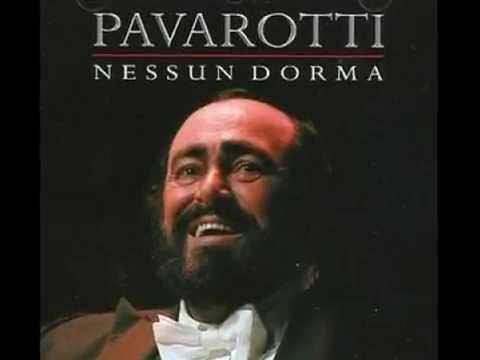
https://www.youtube.com/watch?v=rTFUM4Uh_6Y
I'm specifically referring to Pavarotti singing it, because that's my experience with it. The sweeping beauty of the orchestra, and this great man's voice, bring me closer to God.
The song: Glorious

https://www.youtube.com/watch?v=GytW_rgr0RM
Sometimes we don't feel like we're fitting in or have a purpose, or that we're loved. Stephanie Mabey and David Archulete remind us that we're all part of God's plan.
God loves us, and He gave us people in our lives to lift us and inspire us. More than that, He gave us His Son. I'm so grateful.
16 January 2018
A review of Sakyong Mipham's book, The Lost Art of Good Conversation
I think people are getting rude. I don't notice this so much in conversations where the parties are physically present, though it does occasionally happen, I mostly see it online, particularly Facebook. People are anonymous so they can say angry, hurtful things, or make fun of others. Or, they are speaking to a faceless multitude, so they feel no need to moderate their opinions. I don't know the extent to which I do this. I haven't got much of an online presence; I usually just chat with Amazon reps when something goes wrong with my order. But I've deliberately attempted to switch my chats from I am a displeased customer and you need to fix this to Something went wrong, and I'd really like your help figuring it out. So one reason I was interested in reading a book called The Lost Art of Good Conversation: A Mindful Way to Connect with Others and Enrich Everyday Life is: I'd love to see and be a part of the return of greater civility.
The second reason I wanted to read The Lost Art of Good Conversation was that during bipolar depressive episodes, it becomes difficult to engage in conversation. The simple acts of carrying on a dialogue, making eye contact, and paying attention are abrasive and overwhelming. Especially if it's a small child, who wants to crawl into my lap and get up in my face. I want my conversations to be more genuine, and come more naturally even during low energy times for me.

Did it work? Yes. I do think the book is helpful. I did pick up a few pointers and a few thoughts to ponder. In a way it was kind of a sticky read though: I couldn't read it for very long at a stretch without feeling like getting up and doing something else, and the language is a little flowery at times.
A lot of this book stresses mindfulness and meditation, focusing on the physical acts of the conversation, even to the point of including a chapter about breathing. There's a lot of advice on how to be mindful, and some warnings about what may happen if we are not:
When neither individual is willing to touch nowness, the conversation lacks dignity. It becomes habituated and superficial. Questions and answers become rote. Intriguing words become ordinary. (p. 41, pp. 2)
The book addresses the way we talk to different people, even going so far as to say that our interactions with the cashiers at the grocery store are important. Another chapter goes into the time and place of the conversation. When Sakyong Mipham suggested that walking while talking can facilitate a conversation, it brought to mind the many conversations I've had with my husband as we go on walks, and how the experiences are a treasure to me.
One thought I particularly enjoyed was about patience. Mipham said, "It is said that patience is the guardian of our good qualities." (p. 184 pp. 2) I love that thought, and it truly makes me want to be a more patient person. I certainly need my good qualities guarded, and I can see the truth in this statement.
This book has made me more aware of how I engage in conversation, and I can see some improvement in my interactions with others. I won't say that I suddenly feel up to the challenge of talking to people during severe depressive episodes, but the interactions I do have are more meaningful.
The book does have it's difficult moments; like a chapter that was advocating talking slowly, but wrapped up by mentioning how rapidly some cultures speak, and saying this was based on mindfulness and awareness. One paragraph that went beyond me was about wisdom:
Wisdom - that which never needs to be expressed - allows for conversation to occur. ...One can see words as expressions of wisdom, and wisdom as the element of the inexpressible in each word. ... Words are like wisdom expressing wisdom to itself. (p. 219, pp. 2)
Although this book could be a dry read at times, I do feel like my time was well spent in improving myself and taking the time to be more intentional about how I interact with others. The book didn't really delve into how we interact through texts and online communications, but there were plenty of thoughts that could be extrapolated. I do recommend this book if you're looking for an "improving book".
I received this book from Blogging for Books in exchange for my review. This is my honest opinion about the book.
More info:
About the book: https://www.penguinrandomhouse.com/books/550804/the-lost-art-of-good-conversation-by-sakyong-mipham/
About the author: https://www.penguinrandomhouse.com/authors/68526/sakyong-mipham/
The second reason I wanted to read The Lost Art of Good Conversation was that during bipolar depressive episodes, it becomes difficult to engage in conversation. The simple acts of carrying on a dialogue, making eye contact, and paying attention are abrasive and overwhelming. Especially if it's a small child, who wants to crawl into my lap and get up in my face. I want my conversations to be more genuine, and come more naturally even during low energy times for me.
Did it work? Yes. I do think the book is helpful. I did pick up a few pointers and a few thoughts to ponder. In a way it was kind of a sticky read though: I couldn't read it for very long at a stretch without feeling like getting up and doing something else, and the language is a little flowery at times.
A lot of this book stresses mindfulness and meditation, focusing on the physical acts of the conversation, even to the point of including a chapter about breathing. There's a lot of advice on how to be mindful, and some warnings about what may happen if we are not:
When neither individual is willing to touch nowness, the conversation lacks dignity. It becomes habituated and superficial. Questions and answers become rote. Intriguing words become ordinary. (p. 41, pp. 2)
The book addresses the way we talk to different people, even going so far as to say that our interactions with the cashiers at the grocery store are important. Another chapter goes into the time and place of the conversation. When Sakyong Mipham suggested that walking while talking can facilitate a conversation, it brought to mind the many conversations I've had with my husband as we go on walks, and how the experiences are a treasure to me.
One thought I particularly enjoyed was about patience. Mipham said, "It is said that patience is the guardian of our good qualities." (p. 184 pp. 2) I love that thought, and it truly makes me want to be a more patient person. I certainly need my good qualities guarded, and I can see the truth in this statement.
This book has made me more aware of how I engage in conversation, and I can see some improvement in my interactions with others. I won't say that I suddenly feel up to the challenge of talking to people during severe depressive episodes, but the interactions I do have are more meaningful.
The book does have it's difficult moments; like a chapter that was advocating talking slowly, but wrapped up by mentioning how rapidly some cultures speak, and saying this was based on mindfulness and awareness. One paragraph that went beyond me was about wisdom:
Wisdom - that which never needs to be expressed - allows for conversation to occur. ...One can see words as expressions of wisdom, and wisdom as the element of the inexpressible in each word. ... Words are like wisdom expressing wisdom to itself. (p. 219, pp. 2)
Although this book could be a dry read at times, I do feel like my time was well spent in improving myself and taking the time to be more intentional about how I interact with others. The book didn't really delve into how we interact through texts and online communications, but there were plenty of thoughts that could be extrapolated. I do recommend this book if you're looking for an "improving book".
I received this book from Blogging for Books in exchange for my review. This is my honest opinion about the book.
More info:
About the book: https://www.penguinrandomhouse.com/books/550804/the-lost-art-of-good-conversation-by-sakyong-mipham/
About the author: https://www.penguinrandomhouse.com/authors/68526/sakyong-mipham/
06 December 2017
A review of Do One Thing Every Day That Makes You Happy journal

As a book title, Do One Thing Every Day That Makes You Happy is a mouthful. As an outlook on life, it's a really good one. I have bipolar disorder, which mostly manifests as depressive episodes. I understand a lot about not feeling happy. I've had bipolar disorder for long enough to recognize that I have a good life - a great life, a blessed life - even when I can't feel it. And I have learned to feel grateful even through the depression for the blessings. And to enjoy moments of happiness wherever and whenever I can get them. Even though no one can have a great day every day, or even all day for one day for every second of that day, there can be happy moments even on the saddest days.
Do One Thing Every Day That Makes You Happy focuses on small moments of gifts of happiness, drawing our attention to those times and helping us see the good. I like this book right from it's cheerful yellow color. The format of the book is fairly simple; there are quotes about happiness, or things that bring people happiness, or even just pithy in general, and then there are writing prompts. This is a small book (I'm guessing 6" tall,1"ish deep - the picture is almost actual size), there's not a lot of room to write. The benefit of this is to make us sum up a happiness, and focus more deeply. It helps us be mindful and intentional. We have to deliberately think of happiness and recognize it in our lives.
An example page from the journal reads:
A joyful and pleasant thing it is to be thankful.
Bible, Psalm 147
What made me thankful today:
(unpaginated)
Only in the book it's written in orange, and a more fun font, and it's clear that their graphic designers care about their work, it's beautifully done. My response was:
My mom helping me clean my house and take care of my kids and God getting the van sorted out.
There should be a comma in there, but it's a journal, so I'm not going to beat myself up. My point is: In one sentence, grammatically correct or not, I just summed up blessings so huge just seeing it in small print made me see their enormity.
I don't write in this book every day, or most days, but I've had moments that I was in a terrible mood, saw the book and picked it up and chose an entry. This book is kind of buffet style, you just pick and choose whichever entry you want - I've skipped all over the place.
I can't say that I'm a fan of the come-back-later entries. One page prompted me to make up my mind to be (fill in the blank), and provided a list of attitudes (e.g. glad, jubilant, gleeful, content) to choose from. I usually journal at night, so this one required forethought - not that planning ahead is a bad thing, but I don't usually feel up to the extra step. Lazy, but true.
I like this book, and I think it's important, because we need to do our part to be happy, and not expect life to do all the work for us.
I received this book from Blogging for Books in exchange for my review. This is my honest opinion about the book.
more info:
https://www.penguinrandomhouse.com/books/545009/do-one-thing-every-day-that-makes-you-happy-by-robie-rogge-and-dian-g-smith/
author bio:
https://www.penguinrandomhouse.com/authors/170809/robie-rogge/
31 August 2017
A review of Mark Crilley's book, Manga Art

Manga Art, by Mark Crilley, is not what I expected it to be. I thought it was going to be a how-to book on drawing manga, and since I've checked out one artist's take on that, I was interested in seeing how a different artist would approach it.
This is not a how to draw book. Although Mark Crilley is an art teacher, and has YouTube videos teaching drawing techniques, this book is a collection of artwork by him for him (and us), where he got to explore his art and style. I loved it! Reading this book was like going to see a special exhibit in a museum. And getting to stop and look at all the pictures, for as long as you want. And reading the little plaques next to the display. As a mother with young children, that's a pretty awesome experience. One of the rules of childhood seems to be: If you can't climb on it, it's not worthwhile. Which means I don't really do museums right now.
Except I feel like I did. I got to see this huge collection of art. Have a little "discussion" about what art means with Mr. Crilley. Take time just staring at something beautiful. It sounds neurotic, but it was totally a much needed mommy break - that and I really loved the artwork.
My favorite piece was called Glomp!

https://autodo.info/pages/c/chibi-glomp/
It looks a lot like this. Which is basically how I feel when I see my husband.
The book was divided into five different segments: Characters, Japan, Science Fiction, Conceptual Art, and Styleplay. Each picture has an explanation about why Crilley chose to do the particular piece, and how he did it, and maybe ways it challenged him as an artist. My favorite section was Styleplay, and it was fun seeing if I recognized which artist Mr. Crilley was emulating. Some were unmistakable, like an homage to the creator of Calvin and Hobbes entitled The Watterson Tree. Some were just styles in general, like "looser brushstrokes". I really enjoyed reading Manga Art and I would recommend it to people interested in that art form, even if you just checked it out from the library.
I received this book from Blogging for Books in exchange for my review. This is my honest opinion about the book.
08 August 2017
To refugees coming to America
Dear Stranger,
Welcome to America! May you enjoy every freedom this country has to offer. May you be welcomed by those you come amongst, and may you find many helpful people to see you through your transition to a new homeland. I am so sorry you were forced from your homeland. I can't imagine the pain and terror you have experienced. I am so sorry you were forced to leave loved ones and possessions. I know from my limited ability to speak a foreign language that it can be so hard to express yourself, yet people will be judging you by those limited expressions. You are brave and you are strong.
There are people who will view you as a threat to their safety, their jobs, their tax dollars, their way of life. These people can be quite vocal. Some of them will be very rude. Please don't judge all of us by those unkind individuals. We are happy to have you. We hope you will feel welcome in our homeland for as long as you care to stay. We pray for those you were forced to leave behind, that their lives will be protected, and that peace will return to their land. We are so grateful for the good that you will contribute to our society. We are grateful for the opportunity we have to learn from you. Welcome to America, and, we hope, welcome home.
Welcome to America! May you enjoy every freedom this country has to offer. May you be welcomed by those you come amongst, and may you find many helpful people to see you through your transition to a new homeland. I am so sorry you were forced from your homeland. I can't imagine the pain and terror you have experienced. I am so sorry you were forced to leave loved ones and possessions. I know from my limited ability to speak a foreign language that it can be so hard to express yourself, yet people will be judging you by those limited expressions. You are brave and you are strong.
There are people who will view you as a threat to their safety, their jobs, their tax dollars, their way of life. These people can be quite vocal. Some of them will be very rude. Please don't judge all of us by those unkind individuals. We are happy to have you. We hope you will feel welcome in our homeland for as long as you care to stay. We pray for those you were forced to leave behind, that their lives will be protected, and that peace will return to their land. We are so grateful for the good that you will contribute to our society. We are grateful for the opportunity we have to learn from you. Welcome to America, and, we hope, welcome home.
14 July 2017
A review of David Chelsea's book, Perspective in Action

How you feel about David Chelsea's book Perspective in Action, is a matter of...perspective. And my perspective is that of an amateur artist who's always had a little bit of difficulty with perspective and proportion. If you're coming from a similar perspective, this book is not for you. This book is highly technical.
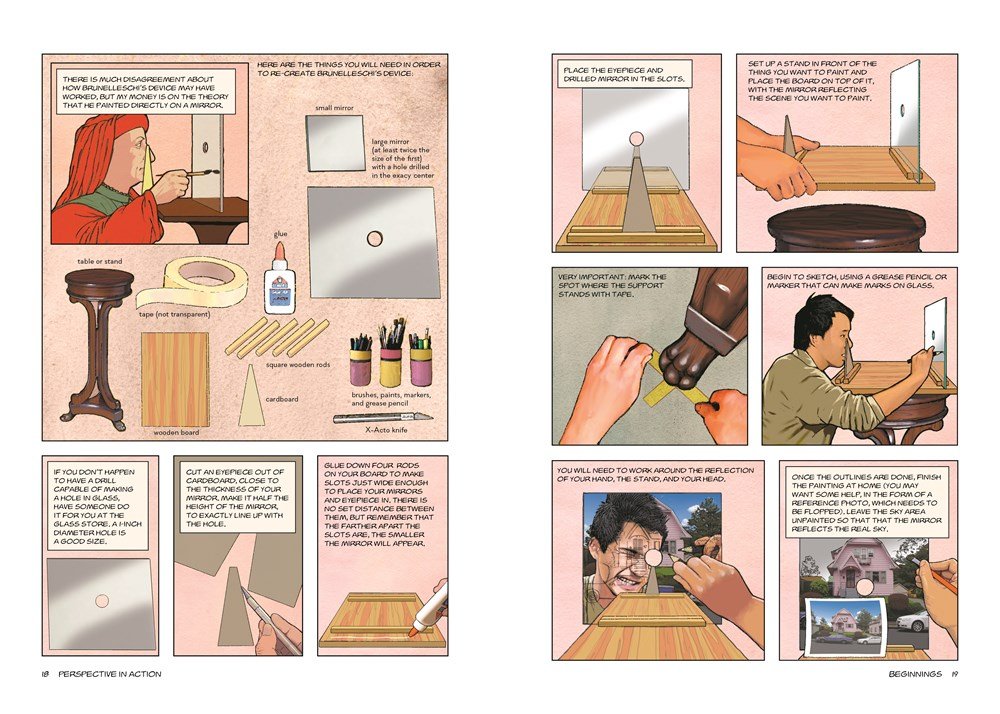
(https://www.amazon.com/Perspective-Action-Exercises-Representation-Renaissance/dp/1607749467)
It went over my head. I should have been a little bit clued in by the tagline on the cover "Creative exercises depicting spatial representation from the Renaissance to the Digital Age.", but I wasn't. I figured by "exercises" it meant fifteen - forty-five minute drawing exercises meant to hone one's skills and help improve one's understanding of perspective. This is not the case. This book is for hardcore prospective perspective acolytes. This book is for people who's careers depend on their perspective ;)
Here's one of the suggestions I decided not to follow through on:
"If you would like the sharpest possible image, follow the equation below to determine the best diameter pinhole for the distance between pinhole and wall surface. Since my bathroom is 6 feet deep, the optimum pinhole width is approximately 1.5 mm."
...actually, I'm going to have to stop with that example, because I can't figure out how to blog the equation. Meh. Suffice it to say, it was higher math and I wasn't interested.
So in the end, I wasn't actually qualified to review this book. Overall impressions: Highly techinical, and if you actually took the time to do the exercises described you would be spending an enormous amount of time and effort on it, and I think maybe the real purpose is for the perspective buffs out there to follow along philosophically speaking, nodding their heads and murmuring, "I see..." The author occasionally made remarks I found humorous. On two occasions the artist used nude illustrations to demonstrate a point that seemed more naked than nude - there was no point to the illustration choice, any other image would have done, so I wasn't a fan of that.
Maybe this is a really great book, but I'm never going to know. I do have a lot of respect for the technical skill and knowledge that went into this.
I received this book from Blogging for Books in exchange for my review. This is my honest opinion about the book.
23 May 2017
A review of Matthew Paul Turner's book, When God Made You, illustrated by David Catrow
People say not to judge books by their covers. This can be true. I bought one of my very favorite books used on Amazon once, and it came with a truly horrific cover. It's actually off-putting. The irony is, the reason that I checked the book out of the library when I first discovered it was because of its different, appealing and interesting cover. I find that I can usually tell if I'm going to like a book by its cover.
Matthew Paul Turner and David Catrow's book, When God Made You, is no exception. You can tell right when you look at it that when God made you it was a happy thing, and that you should be very glad to be you.

The pictures and words in this book really flow together, and Mr. Catrow does an amazing job expressing exuberance and joy and delight. It's almost abstract, but you understand the sentiment. As you can conceive from the front cover, there is a real sense of soaring in the book, even literally depicted. The words are descriptive, and convey the powerful truth that we are known and loved by God. It's a fun reinforcement for children that God made us on purpose, exactly how we are.
Really the only issue I have with this book is that the rhymes don't always flow in a way that feels natural to me. It can make for an occasional hiccup in the reading.
What child, or adult, doesn't need to remember that they are God's? To borrow Mr. Turner's words:
" 'Cause when God made you
and the world oohed and aahed,
in heaven they called you an image of God."
I thoroughly enjoyed this book, and I know that I will be reading it to my children many times in the future.
Want more info?
http://waterbrookmultnomah.com/books/537389/when-god-made-you-by-matthew-paul-turner-illustrated-by-david-catrow/
Want to know more about the author?
http://waterbrookmultnomah.com/authors/82928/matthew-paul-turner/
I received this book from Blogging for Books in exchange for my review. This is my honest opinion about the book.
Matthew Paul Turner and David Catrow's book, When God Made You, is no exception. You can tell right when you look at it that when God made you it was a happy thing, and that you should be very glad to be you.
The pictures and words in this book really flow together, and Mr. Catrow does an amazing job expressing exuberance and joy and delight. It's almost abstract, but you understand the sentiment. As you can conceive from the front cover, there is a real sense of soaring in the book, even literally depicted. The words are descriptive, and convey the powerful truth that we are known and loved by God. It's a fun reinforcement for children that God made us on purpose, exactly how we are.
Really the only issue I have with this book is that the rhymes don't always flow in a way that feels natural to me. It can make for an occasional hiccup in the reading.
What child, or adult, doesn't need to remember that they are God's? To borrow Mr. Turner's words:
" 'Cause when God made you
and the world oohed and aahed,
in heaven they called you an image of God."
I thoroughly enjoyed this book, and I know that I will be reading it to my children many times in the future.
Want more info?
http://waterbrookmultnomah.com/books/537389/when-god-made-you-by-matthew-paul-turner-illustrated-by-david-catrow/
Want to know more about the author?
http://waterbrookmultnomah.com/authors/82928/matthew-paul-turner/
I received this book from Blogging for Books in exchange for my review. This is my honest opinion about the book.
11 May 2017
A review of Karen Salmansohn's book, Open When...Letters to Lift Your Spirits

Everyone likes getting things in the mail. My father once remarked that he even enjoys getting bills, because it means he's alive...or something to that effect; it was a long time ago. Karen Salmansohn's book, Open when...letters to lift your spirits, is like getting twelve letters all at once. And owing to some clever paper folding, you literally get to open them. It's a fun format.

Image Source: http://notsalmon.com/shop/open-when/
Now it just so happened that when I got this book, I was having a "bad day" and "need[ed] to find [my] happy place," letters number one and number two. I read the letters and thought, "Oh bother. I don't feel like being told to perform mental exercises right now." But I kept reading through the other letters (What can I say? I'm impatient. My amended title to Open When is Open When You Feel Like It. Honestly, I feel like the book is worth a read straight through.); by the end of it I was smiling and wanted to show the book to my best friend. So, sometimes the letter you should be opening isn't the letter you think you should be opening (There's a metaphor for life here.).
I enjoyed this book, and I enjoyed the art. It's a watercolory, peaceful, fun sort of thing. My favorite letter is the last letter, "Open when...you want to smile," but I won't go into details, because that would spoil the fun. It's a good note to end on though.
My daughters enjoyed the book too. My two year old even carried it around with her for a few days, because it was her book. So there's an art review from a toddler for you.
The book can get a little bit preachy-advicey at times, but I think that's mostly when you read it in a bad mood - ironically. Don't read it when you're Really Mad...just sort of mad, then you can practice before you try any of the mental exercises. And don't worry that it is going to be a long read, the picture above gives you a really good idea of how the pages go. Overall I enjoyed this book, and it's one I plan on keeping...or at least, one my daughter plans on keeping.
I received this book from Blogging for Books in exchange for my review. This is my honest opinion about the book.
07 March 2017
A review of Adam Weber's book, Talking With God
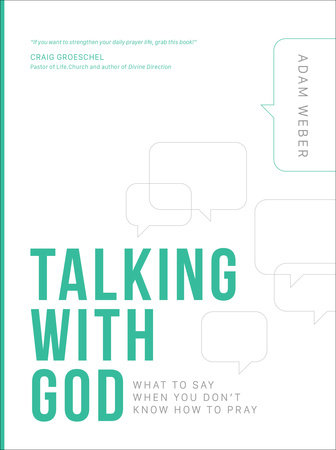 I decided to read Talking With God, by Adam Weber, because I felt like I needed to focus more on prayer, and I wanted to have a fresh perspective on it. The fact that it was written by someone not of my faith, but still a fellow Christian, made me hopeful that I could gain some new insights that would help me build my testimony of prayer.
Reading this book definitely made me remember the many blessings God has given me, and the solace I have found in prayer, and the times when my prayers have been answered more abundantly than I could have hoped. It also reminded me of how much being able to talk to my Heavenly Father has made it possible for me to trust God to see me through hard times and situations - even when they're caused by my own foolishness.
This book could be a little rambling at times, but the layout was simple and easy to follow. Much of the book was anecdotal, but there were a lot of scriptures to back up the author's points. The footnotes threw me off for a little bit, because they were really just side notes, and really not critical to the book (other than scripture references), like foot note 1 in Chapter 2. Easter Bunny: 1. Another year, I got a Salt-N-Pepa CD. Awesome. (p. 189). I do have to admit though, that is the first time I've read every foot note in a book. It can read a bit like a memoir at times, but the author has a light touch of humor, and his experiences he shares are always used to illustrate his point.
I was never bored while I was reading the book. It didn't drag. It was a well-paced sermon on prayer. The book challenged the reader to do a couple of different things, and while I usually skip over challenges, I did a few of these. At one point, Reverend Weber suggested praying for someone, then letting that person know that you were praying for them, and what you had prayed for them. It was a little out of my comfort zone - although I've definitely told people having a hard time that I would pray for them - but, I decided to go for it (I forget which page this challenge is on, by the way). I don't think I'm going to adopt this as a new practice, but I did have a good experience. I was able to communicate to a friend that I care, and that I have a testimony that God cares.
I felt like this book lacked a little bit of the reverence I have for my Heavenly Father. I understand, as Reverend Weber was demonstrating his point throughout that Jesus and Heavenly Father are our friends, but I would have loved to have seen a touch more deference.
Overall, I'm glad I read this book. Not only did it give me the opportunity to think over my relationship with Heavenly Father, but it reminded me that God answers the prayers of all of His children, and that He is happy anytime one of His children comes to Him in prayer.
I recommend this book to those who are looking for a beginning or review perspective on prayer.
Want to know more about Adam Weber?
http://waterbrookmultnomah.com/authors/2136344/adam-weber/
Want more info about the book?
http://waterbrookmultnomah.com/books/539236/talking-with-god-by-adam-weber/
I received this book from Blogging for Books in exchange for my review. This is my honest opinion about the book.
26 February 2017
To people who are feeling burned out.
Dear Fatigued Stranger,
I'm feeling it too. Like a wind-up toy losing power. Like a gerbil in a wheel. Like a playlist on repeat. You get the point. We're tired of the daily grind, and we feel like we can't keep going, but we have to: for work, for our kids, for our family, friends, spouses, random acquaintances or strangers asking us to support a cause. There are so many demands.
If you're feeling like a fire going out, it's time to bank the fire. Keep it low but alive. A man who has my deepest respect used an airplane analogy (Dieter F. Uchtdorf, https://www.lds.org/general-conference/2010/10/of-things-that-matter-most?lang=eng): when we fly through turbulence, we sometimes think we should proceed full speed ahead and get it over with, but we really lessen the turbulence by slowing down. So just keep it simple. Don't do anything extra.
A friend needed my help last week. And I said no. This might have made me a terrible friend. Jesus gave us a phenomenal example of service and sacrifice. Shouldn't I have said yes to my friend? And I say "No." You cannot give what you do not have. If you ask me for a golden elephant the size of my head, I can wish and wish and wish I could give it to you, but I don't have one.
Say no to people. There may come a genuine emergency, and you cannot say no, but these are exceedingly rare. Say no to being busy and running around frantically. Realize that there are some essential things in life that cannot be ignored, but these also are not as numerous as we think.
So just wait. The time will come to say yes. The time will come to do more. I have lived long enough to know that somehow we'll get more firewood from somewhere - even if that takes awhile.
But for now, be still. Know that God is God.
I'm feeling it too. Like a wind-up toy losing power. Like a gerbil in a wheel. Like a playlist on repeat. You get the point. We're tired of the daily grind, and we feel like we can't keep going, but we have to: for work, for our kids, for our family, friends, spouses, random acquaintances or strangers asking us to support a cause. There are so many demands.
If you're feeling like a fire going out, it's time to bank the fire. Keep it low but alive. A man who has my deepest respect used an airplane analogy (Dieter F. Uchtdorf, https://www.lds.org/general-conference/2010/10/of-things-that-matter-most?lang=eng): when we fly through turbulence, we sometimes think we should proceed full speed ahead and get it over with, but we really lessen the turbulence by slowing down. So just keep it simple. Don't do anything extra.
A friend needed my help last week. And I said no. This might have made me a terrible friend. Jesus gave us a phenomenal example of service and sacrifice. Shouldn't I have said yes to my friend? And I say "No." You cannot give what you do not have. If you ask me for a golden elephant the size of my head, I can wish and wish and wish I could give it to you, but I don't have one.
Say no to people. There may come a genuine emergency, and you cannot say no, but these are exceedingly rare. Say no to being busy and running around frantically. Realize that there are some essential things in life that cannot be ignored, but these also are not as numerous as we think.
So just wait. The time will come to say yes. The time will come to do more. I have lived long enough to know that somehow we'll get more firewood from somewhere - even if that takes awhile.
But for now, be still. Know that God is God.
01 February 2017
A review of John Donvan and Caren Zucker's book, In a Different Key: The Story of Autism

When I decided to read In a Different Key, it was on a whim. I selected it sight unseen, and expected a quick, but thoroughly educational, read. In a Different Key is a tome. At 552 pages before the timeline, notes, bibliography, acknowledgements, and authors' note, it is a literally heavy read.
My first note is, that this is an obviously thoroughly researched book. The material comes from a wide range of sources, and covers a wide range of information.
Second, I learned a lot. In an age where a lot has been done to break down previous misconceptions and stigmas about disabilities, it can be easy to forget that truths we hold to be "self-evident" actually had to be fought for.
Third, it is repeatedly demonstrated that the passion and compassion of dedicated parents, and those who support them, have been the key motivating factors in improving the lives of those with disabilities - in this case, particularly those who have autism.
I didn't enjoy this book. It was a heavy read. Metaphorically as well. It's not pleasant reading about the conditions and experiences families and individuals were subjected to. I get that. But to me there was also a sense of scandal-mongering. Over and over again, I felt like it was "and here's our Hero...with one dirty little secret." With two outright, "Dun-duh-dun! He's really the Villain in Disguise!" moments thrown in there as well. A blurb by Washington Post on the cover touts the book as "chock full of suspense." I'm not so much looking for suspense from this book, as I'm looking for a clearer understanding of what autism is and more about the people who have the condition. Some of whom I know. Also, I did not enjoy the not infrequent use of offensive language - even in verbatim quotes I felt could have been paraphrased. This was ironic to me, as the authors were so conscientious and careful about trying not to offend others by their historic use of terms currently politically incorrect, such as "imbecile" and "moron." Another off-putting thing, for me, was the way the authors would start a topic, leave, and then come back a chapter later. One chapter talked about the vaccine-autism correlation study done by Andrew Wakefield, the next about a national organization of autism advocacy formed, followed by Villain Wakefield being exposed. It all ties in, in the end, but I found it wearisome.
And about learning a lot: I unquestionably did. But I feel like what I learned about, was more about the perceptions of autism than autism itself. Understandable, since a key point of the book was that autism has always been hard to define and diagnose, and that a lot of the time people are using the word to mean different things, while the masses assume they are talking about a unified whole.
I recommend this book to sociologists and historians. To the casual, even though interested, reader, I think it's a bit much.
I received this book from Blogging for Books in exchange for my review. This is my honest opinion about the book.
09 January 2017
A Review of Barbara Park's Junie B. Jones First Ever MUSICAL Edition (audio book)

I remember seeing friends and classmates reading books in the Junie B. Jones series in elementary school, and I meant to read them, but for whatever reason, I never got around to it. I wasn't really sure what to expect, but my sister told me that it was a really good portrayal of life through the eyes of a little girl, and she was right. The Junie B. Jones First Ever MUSICAL Edition is a reading of Junie B. Jones First Grader (at Last) and a studio recording of the songs from the musical, and it proved to be a really good introduction into the world of Junie B. Jones.
We decided to listen to the audio book during a long car trip we took over the weekend and that turned out to be a really good idea, since we got stuck in traffic immediately after we left. The reader, Lana Quintal, was lively and engaging, and she got the voice dead on. I think these stories must be meant to be read aloud, because that was the perfect medium. This was a good fit for a younger audience, too. My six-year-old was disappointed that it wasn't a print book, because she had wanted to be able to look at the pictures (Do the books have pictures? That would be fun.), but she really enjoyed listening to it.
We joined Junie B. on her first day of first grade, and got to hear what she thought about best friends, school bus seatmates, and trying something new, and maybe a little bit scary. The story was fun and captured a child's viewpoint admirably. My husband and I kept exchanging glances throughout the story, like we were sharing memories of life in grade school, and remembering "that girl" or "that guy" from our own classes. I don't see parents who are reading or listening to this book with their children being bored by it at all. It's easy to relate to, and I think a lot of us might still have a little bit of Junie B. still inside of us as we encounter the world. I half-wished the story were more grammatically correct, but it would have lost some of its voice and charm. The story was pretty short, but it was the perfect length for those just learning to listen to or read chapter books.
Over the summer our family went to see Pinkalicious the Musical, and we loved it, which is one reason I was interested in hearing the music from the Junie B. Jones musical. Overall, my reaction was favorable, but I think my enjoyment would have been far greater if I had any familiarity with other books in the Junie B. Jones series, as the musical was based on several of them. It also would have been nice to be able to see the musical before hearing it, because there were moments in some of the songs that clearly would have been more fun as a stage performance. If I have a criticism of the music, it is an occasional tendency on the part of the music to start sounding all the same.
This is a highly enjoyable book, and it made me interested in other books in the series. My kids, who slept through part of it as a result of moving 2 mph in a warm car, asked to listen to it again on the drive home, and laughed together later about parts the thought were funny. If you have young school-aged children, and are looking for a book or audio book to enjoy together, this is a great option.
Want to learn more about the late Barbara Park? http://www.penguinrandomhouse.com/authors/23194/barbara-park/
Want to learn more about the audio book? http://www.penguinrandomhouse.com/books/532844/junie-b-jones-first-ever-musical-edition-by-barbara-park-with-songs-by-marcy-heisler-lyrics-and-zina-goldrich-music/
I received this book from Blogging for Books in exchange for my review. This is my honest opinion about the book.
20 December 2016
A Review of Lisa Yee's: Batgirl at Super Hero High (audiobook)

My now six-year-old has been asking for a Batgirl birthday party for the last six months, so we've definitely had Batgirl on the brain over here. Her sisters are likewise obsessed with superheroes (my two-year-old is currently walking around in a Wonder Woman dress she put on all by herself), so I knew they'd all be interested in an audio book about Batgirl. And as a mom of three daughters, I'm always on the lookout for suitable "girl power" books that teach good values, portray women and girls as strong and capable, and avoid male-bashing.
Lisa Yee's Batgirl at Super Hero High is about Barbara Gordon, a.k.a Batgirl, trying to fit in at her new school, Super Hero High, find a good balance in her relationship with her overprotective father, and figure out if someone who wasn't born super can truly become a superhero.
The audio book is read by Mae Whitman, and she does a good job. One could wish for a little bit more animation at some points, but on the whole she has a clear, strong voice that is easy to listen to - and believe me, as someone who has quit listening to an audio book because the reader gave characters really annoying voices, this is important.
The story made a good audio book. There are stories that you find yourself flipping back in the book with a "Say what!?!" as you look for that paragraph that contained some key plot point that the author tucked in surreptitiously, but Batgirl follows a direct narrative that is easy to follow.
The story itself: First of all, you need to be aware that Batgirl at Super Hero High is the third book in the Super Hero High series (a fact that I somehow missed). It is clear from the first chapter that previous events are being built on. Although the author didn't really revisit prior material much, I was still able to follow the story just fine. I enjoyed the positive messages conveyed by the book as it dealt with themes of friendship, parent-child relationships, accepting help, and standing alone. Specific messages I appreciated included:
Children can make their parents better people. Children need to understand that they are a positive and treasured part of their parents lives, and that their parents are trying to be their best selves for their children.
Being a hero is more about strong values than awesome powers. Even the villains have awesome powers, but they aren't using them to serve and protect. The supers embrace a strong moral code, and embody principles like courage, conviction, honor, perseverance, compassion, and loyalty.
Interdependence is not dependence. I love the strong message that teamwork is not a weakness on the journey to becoming strong and independent. It's okay to ask for help, and it's okay to offer help, and it's okay to ask for the opportunity to try on your own.
What did I not like? There was one moment in the book that jarred me strongly. Roughly paraphrased, the principal tells Batgirl that Super Hero High is different from regular high school because the supers are going to be leaders, saving lives, and changing the world. I think Susan B. Anthony, Marie Curie, Rosa Parks, and Mother Theresa can all agree that you don't need some special super hero academy to change the world, and in ten years when I have girls in high school, I want them to know they can be strong leaders and change lives for the better in their sphere of influence.
Because I jumped into the series, my next criticism may be unfounded, but there was a lot of name dropping from the DC universe, which can be hard to follow if you're a super hero novice. I found myself thinking, "Yeah...I have no idea who that is," frequently. Also, the mixing of villains and heroes is a little odd - I'm getting a kind of Maleficent vibe from the whole thing, which honestly feels a little unoriginal.
I found the book a light, fun read, and I thought Lisa Yee's portrayal of the villain was really well done, and that the character had a lot of depth. I find myself mildly interested in reading the other stories in the series, especially after the obligatory cliff-hanger at the end of Batgirl.
This book is target to 3rd-7th graders, and I think that's an accurate assessment. My four-year-old didn't like the part "When the bad guy... *insert spoiler here*...which messed everything up for everybody." Which is probably the reaction Ms. Yee was going for, so that was on target, but the girls mostly popped in and out of the room, and didn't listen to a whole lot of the book when it was on. I anticipate they'll like it more when they get a little older, and I may play it again a chapter at a time as we play Legos or something, but for now it wasn't a huge hit with them.
So my recommendation is this: for sure read or listen to the first two books first, but this will be a fun story for any mid-late elementary girl (and maybe boy, although clearly targeting a female demographic) who is interested in super heroes, and it's a good "girl power" novel that won't be incredibly boring for any adult who is reading/listening along with their child.
I received this audiobook from Blogging for Books in exchange for my review. This is my honest opinion about the book.
06 December 2016
A Review Of Christopher Hart's Book, doodletopia Fairies

Christopher Hart’s book doodletopia
Fairies is by far my favorite book in the doodletopia series. This may have much to do with the fact that I
have always enjoyed fantasy and magical creatures, fairies in particular, so it
already had brownie points just for subject matter. It’s been awhile since my
last review, but I don’t think I’m imagining that Fairies is more instructional that its predecessors. While still
definitely being a guided activity book, there seems to be more actual art
education involved.
Hart promises that his book will teach you to “…draw fairy
wings, design magical fashions, make flying poses, create charming fairy
villages, produce magical effects in your artwork, and more.” p. 7 and jumps
right in with his first tip. “Indicating size and scale is another important
technique -” p.7 Like, I assume, many others, I often have the most difficulty
- when drawing a character - with the side profile. This time, Hart addresses that: “…known as a side
view - and “the angle that drives people crazy.” Let’s break down the steps to
make it easy to draw.” p. 12. Which he does. Honestly, I think it will continue
to be a problem for me, but I’m half a step closer.
In one regard particularly, Hart has held consistent appeal
for me, and that is his wit. He is just a funny guy. He continues to joke about
his magical ability to imbue his readers with super drawing powers, “Your
pencil is your wand. And your eraser is …still just a rubbery thing. But your
pencil is a wand.” P.13, and make funny remarks about his characters, “They’re
the ones who steal your sunglasses when you’re not looking.” P.7, but I feel
like he waxed even more eloquent on this go round. Again, maybe bias owing to
my enjoyment of the genre, but Fairies has
been funnier to me. My favorite quips?
“Fairies range in age from very
young (about 633 years old) to mature (“It would be rude to tell.”)” p. 10
“I flipped through some popular
fairy magazines, like Fairy Fitness &
Fun, to find insights into what fairies wear. Man, is it tough to read that
teensy print” p. 49
“You can create fairy hats from all
sorts of things. One of the most popular materials is a flower. Lots of
different flowers work. But not dandelions. One good breeze and the hat is
gone.” P. 65
“All I’m saying is that the next
time you see a tiara on a little kid’s head, be sure to tell them, “That was
stolen from a fairy.”” P. 70
“(What time is “yore” anyway? And
how does anyone know when it’s a quarter to yore?)” p. 140
One of Hart’s talents is highlighting how positions and
shapes impact your impressions of the attitude of the character. In fact, his
section headings for “More Fairy Faces” and point blank on the topic: “Oval-Faced
Fairies are Fun” p. 18 “Angular-Faced Fairies Are Confident” p. 19 “Round-Faced
Fairies are Perfect at Pouting” p. 20 “Young Faces Look Innocent” p. 21. He also has more subtle suggestions for how
to convey the characters’ outlook:
“Draw eyes wide, giving her a
bubbly appearance.” p. 10
“Draw the antennae leaning forward, for a
positive look.” P. 35
“Press his arms and legs together
for an insecure pose.” P. 43
“These wings may not seem unique at
first, but their position is interesting. Both sets of wings are lifted up,
which enhances the effect of her cheerful expression.” P. 87
“Notice how the wings are in the “down”
position. This placement can be used to show a negative attitude.” P. 108
This book is not a technical drawing book. While there is
some flat-out art speak, most of Hart’s advice comes in a far more
conversational tone. Topics of art classes are slipped in as a casual aside. I
have twenty specific examples of this, but will omit most of them for brevity’s
sake. But I will add just a few as supporting evidence. For instance, Hart does
not discuss background/foreground, but he does give advice about it: “First
draw the ring of flowers, and then the hat. The flowers are the front layer.” p.
68 or “Overlap the mushrooms below her.” p. 97. He doesn’t talk about light
sources, but he alludes to it: “Draw a shadow under the fairy to indicate that
she’s hovering above the ground.” p. 98. Nor does he talk about diagonal lines
being more visually interesting and stimulating than horizontals, but merely
suggests, “The horn is such a linear instrument. You either have to position it
horizontally or diagonally. I think you’ll find that diagonally is more
engaging.” p. 143
He also gets into the physics that make art more convincing,
such as being aware of gravity and other forces acting upon your character,
such as momentum creating an updraft on a fairy’s wings.
After the promise of malevolent fairies, I was a little
disappointed about their treatment in the book. After a promising start (“You
may never have actually seen an evil fairy, but you have seen their effects.
Why do you think a slice of bread always falls jelly-side down? Evil fairy. Why
can you never find your glasses? Evil fairy.” p. 114), just one page of advice
- maybe just hints (“Push those eyebrows down - way down!” p. 114), and one
page of go to (“Wicked characters drip with evil. So by all means, overdo it!”
p. 115)! Maybe there wasn’t a lot to say about it, but I’d have liked to have
seen further exploration of the topic.
The girls and I really enjoyed this book, and I would
recommend it to anyone whose interests in art and fairies overlap.

I tried to scan my daughter’s adorable artwork, but it turns
out she drew too lightly for my scanner, but here’s a page I did.
I received this book from Blogging for Books in exchange for my review. This is my honest opinion about the book.
23 October 2016
A Review of Christopher Hart's Book, doodletopia Manga

Christopher Hart's manga book is humorous, the design is engaging, and it is replete with examples of different manga forms, from classic school girl, to chibis, to "super cute animals". There a lot of different drawing prompts and activities, from "make your own bookmark" to "finish this maze."
I see this book as an excellent option for long car/plane rides - assuming that you don't suffer from motion sickness. My children loved this book; the baby scribbled, and the others did a kind of fill in the blank version; eyes on faces, lines on the mazes, words on the stationary activity pages.
I still don't find there to be a lot of drawing instruction in this second book in the doodletopia series. In my view, this book is geared toward those who already have basic drawing skills down. However, I did have an art teacher whose primary piece of advice was "draw what you see," and there is plenty to see.
Do I recommend this book? Sure. It's good clean fun, and as I mentioned before, would be great for times where one is required to sit for an extended period of time. I am especially recommending this book for preteens and early teens, because I think they would derive the most enjoyment from it.
more info: http://www.penguinrandomhouse.com/books/238090/doodletopia-manga-by-christopher-hart/
author bio:
http://www.penguinrandomhouse.com/authors/74446/christopher-hart/
I received this book from Blogging for Books in exchange for my review. This is my honest opinion about the book.
28 July 2016
A Review of Josh Chetwynd's Book, The Field Guide to Sports Metaphors: A Compendium of Competitive Words and Idioms

I give up. Less than thirty pages from the end, I am finally "throwing in the towel" to use a sports term from Josh Chetwynd's book, The Field Guide to Sports Metaphors: A Compendium of Competitive Words and Idioms. I do not care if I ever finish this book.
To give credit where it is due, this book fits my idea of a compendium very well. It is exhaustive. And it is exhausting. I had to make myself read it. But back to giving credit, because I feel like I'm doing Mr. Chetwynd a disservice with my abrupt assessment of his work.
So, what did I like:
Small sparks of humor throughout the book. There is a footnote about a horse named Read the Footnotes. The format. It took me a second to process, but once I got used to it, I enjoyed the delineation between phrases, a double bar with the term bolded and in all caps. It can get a little confusing, since the words sometimes occur right at the top of the page where one might expect to see the book title or chapter name, but once you've read through a few entries, it becomes an easy and convenient way to navigate the book. And the idioms are arranged by sport, so it's easy to follow. I liked that with each sport Mr. Chetwynd included a contemporary example of a non-sports usage of an idiom pertaining to that sport. It is also obvious that time and research went into this book.
This book bored me. I am a person who enjoys word origins,who also likes playing sports and occasionally watching them. I thought this book would be a good fit for me, but it turned out to be a little too specific for my taste. Many of the phrases are not very widely used in common parlance, nor is there always a very clear definition provided about what its off-the-field meaning was, so it occasionally felt like a dictionary of sports terms; uninteresting to the casual sportsman. Also, some of the terms were used in a way contrary to how I've heard it used in practice. One example from early on in the book is "batting a thousand" or gushing praise for someone's performance in a particular endeavor. However, the only usage I've heard for this term (Occasionally rendered "batting a million.") is an ironic statement indicating the individual's repeated blunders e.g.. accidentally spilling water on your date, after insulting someone who turned out to be a favorite cousin, after arriving late to the date. "Boy, I am really batting a thousand today!"I don't believe this book is ideal for sitting down and reading straight through. It would be more fascinating flipped through at random. Also, the phrases in general aren't super memorable, so if you read through pages at a time, it kind of just blurs together, leaving one with no interesting tidbits to share in random conversation later on.
There is only one person I can think of that I might recommend this book to: my big brother. He is a sports journalist.
I received this book from Blogging for Books in exchange for my review. This is my honest opinion about the book.
Subscribe to:
Posts (Atom)